|

Bucks Geology Group
Great Linford
Grid reference: SP 846 423 for the
Stone Circle and quarry
Ordnance Survey map:
Northampton and Milton Keynes Sheet 152.
Geological maps:
1:50,000 series Bedford sheet 203.
Bucks County Council administration area:
Milton Keynes.
Owned by:
Various.
Area of site: ha.
Access, location and parking: Great Linford, by the canal. Adjacent sites include the Arts Centre and Church.
Interest Summary: There are four linked sites at great Linford, all a few minutes walk from each other, and all notable occurrences of the Blisworth Limestone. Each show a variety of the typical features of this rock and they all exhibit a different variety or different features. The stone circle and some of the building stones show abundant fossils (brachiopods, oysters and other bivalves).
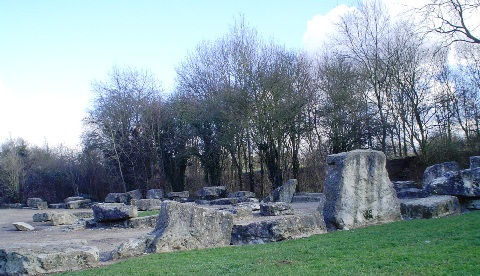
The Stone Circle made from Blisworth Limestone from very close by. Some surfaces show lots of fossils including
brachiopods.
The natural outcrop in the small quarry behind the stone circle can be compared to the blocks chosen for the building stone. In the quarry and on some of the stone
circle blocks, the limestone beds can be seen to alternation with clay layers. These are very obvious as they are also associated with a wavy boundary between
the two. There are several lithological types of Blisworth Limestone to be found within the sites: oolithic, shelly, micritic (clay-rich) and others.
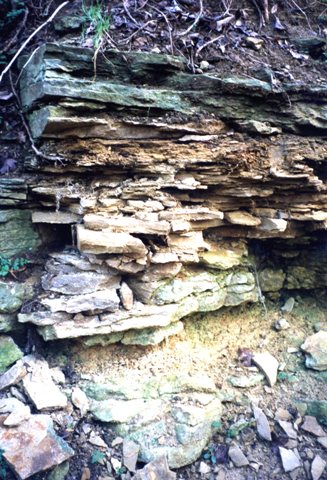
Blisworth Limestone within the small quarry area showing how flaggy it is in these layers, and showing lots of clay
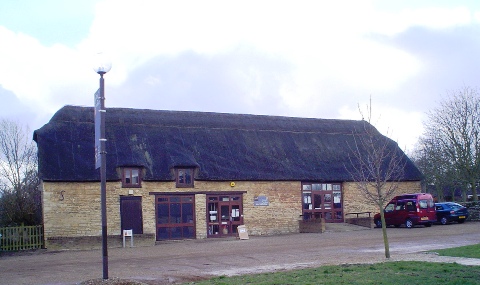
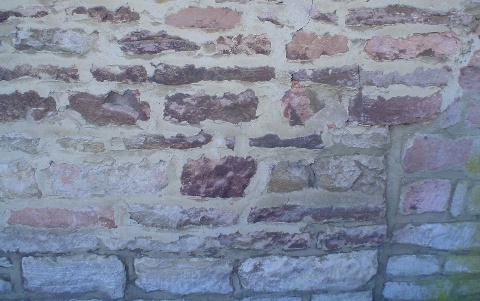
layers too. Within the Arts Centre is an obviously red-stained variety, which is a Northamptonshire
variety of Blisworth Limestone (see photographs below).
The church (see photographs below) has been built over many centuries - the oldest part (the tower) is 12th century, the central building is 13th century, the north porch is 14th
century, with 15th century windows, a 1708 extension to the tower and many other repairs since then. The different building phases and the various
repairs are interesting as the builders have been forced to use what stone was available and affordable at the time. This reveals an interesting mix of local stones, followed by materials brought in from further afield in later times. The church is very worthy of a detailed interpretation on its own.
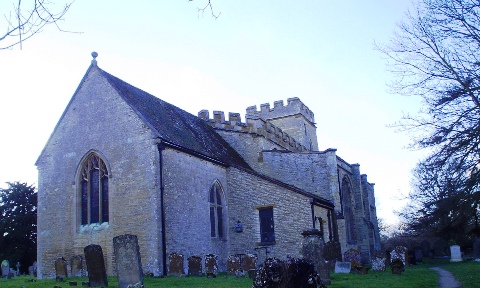
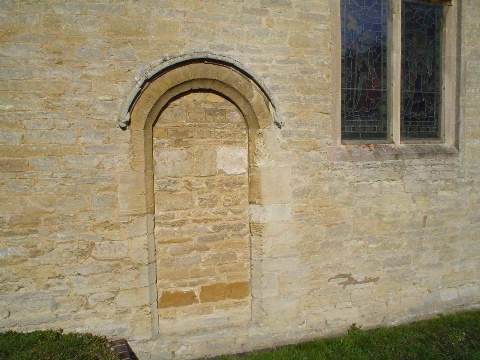
The church at Great Linford, lovely stone and an interesting history
|
