|
Bucks Geology Group
Chalk
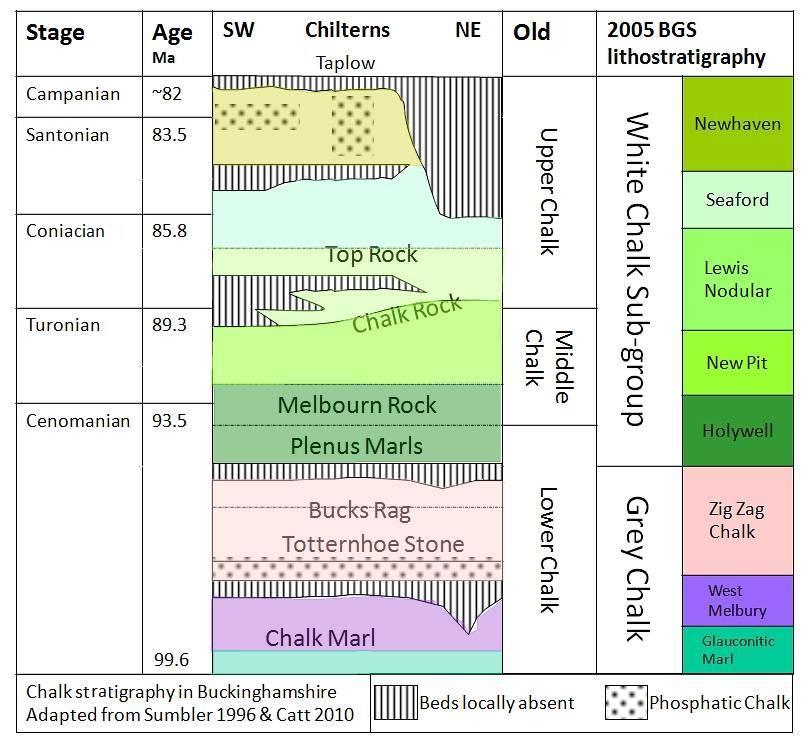
Chalk forms the central backbone of Buckinghamshire, running from east to west and forming the scarp face of the Chiltern Hills. The entire Chalk Group is some 180-190m thick across the county, and is a distinctive soft, white limestone. The basal unit (Grey Chalk Subgroup, or Lower Chalk) has a higher clay content and contains no flint. The higher unit (White Chalk Subgroup, or Middle and Upper Chalk) is nearly pure, 98% Calcium Carbonate, and flint-bearing.
This pure limestone was laid down during a period of global warming. Sea levels rose to an estimated 300+m above present levels, the areas of land receded and the amount of river-borne sediment being brought into the area diminished, explaining its purity. Chalk is almost exclusively formed from the minute remains of fossil algae, called Coccolithophores. The calcite skeletons of these minute organisms invariably disintegrated on death, and descended to the sea-floor, as a soft ooze. Depositional rates must have been slow during this period. The high global temperatures and high nutrient levels in the sea meant that life was abundant. Although the chalk has selectively preserved some organisms over others (for example, calcite shells are preserved whereas aragonite has dissolved) fossils are fairly common, and include the single celled Foraminifera, Ostracods, Brachiopods, Sponges, Bryozoans, Bivalves, fish and even marine reptiles like turtles and plesiosaurs. Other molluscs such as ammonites and gastropods were undoubtedly present, but their shell composition meant that fossilization potential was low, and they are only found at certain levels where preservation was possible.
The Palaeontological Association has produced a book called The fossils
of the Chalk.
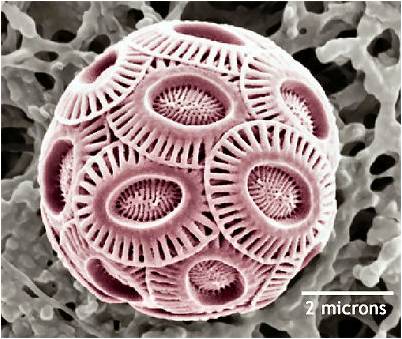
The photo (above right) is an enhanced scanning electron microsope (SEM) image of a Coccolithophore - a tiny
alga composed of spherical plates. Many hundreds of them will fit onto a pin
head! When you rub chalk and get the white powder onto your fingers you will
have just smeared thousands of them between your fingers. [Photo courtesy Dr. Markus Geisen - photographer, and The Natural History Museum. earthguide.ucsd.edu]
Below are a number of fossils which you can expect to find within the Chalk.

This Chalk exposure forms a roadside cutting on the old A41 at Tring Hill.
Further reading suggestions:
Smith, A.B., 2002. Fossils of the Chalk. The Palaeontological Association London.
Images used with permission: © Copyright Buckinghamshire County Museum (Licence No. 44)
|
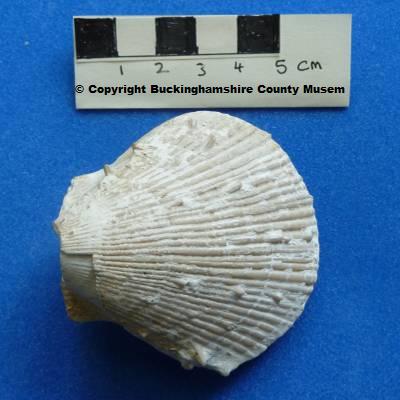 Spondylus spinosus. Spiny bivalve. Bucks County Museum - Lee Collection Specimen No. 1982.278.1792. The bivalve Spondylus, has unequal valves, the larger being covered in long spines which anchored or supported it on the soft sea floor.
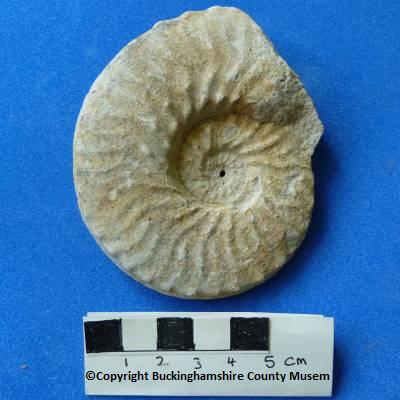 Schloenbachia sp. Ammonite from the Grey Chalk Group, Pitstone. Bucks County Museum - Specimen No. 1968.149.1
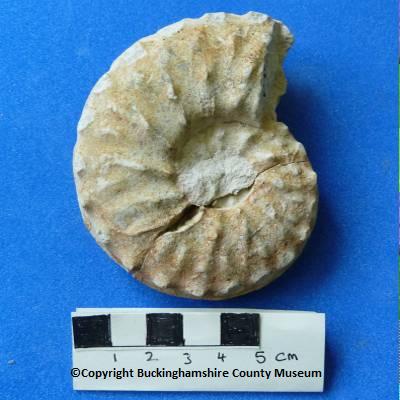 Schloenbachia sp. Ammonite from the Grey Chalk Group, Pitstone. Bucks County Museum - Specimen No. 1968.149.2
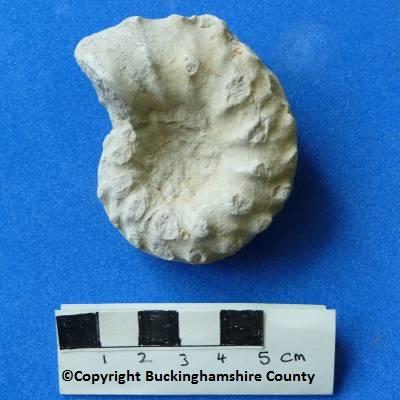 Schloenbachia sp. Ammonite from the Grey Chalk Group, Pitstone. Bucks County Museum - Specimen No. 1968.149.3
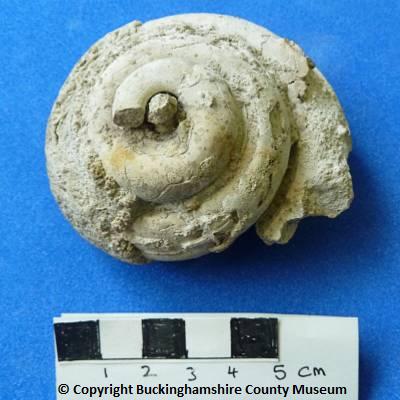 Bathrotomaria sp. Gastropod from Highwycombe, Planus Zone, White Chalk. Bucks County Museum - Specimen No. 1958.25.1
 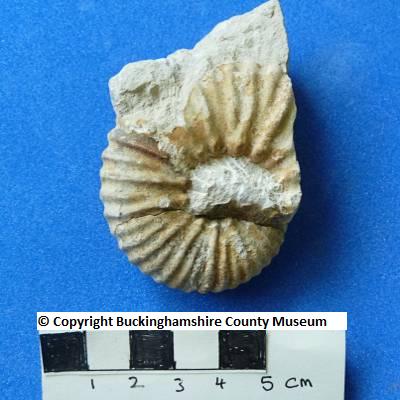 Mantelliceras sp. Ammonite from the Lower Chalk Group, Pitstone. Bucks County Museum - Specimen No. 1967.384.1
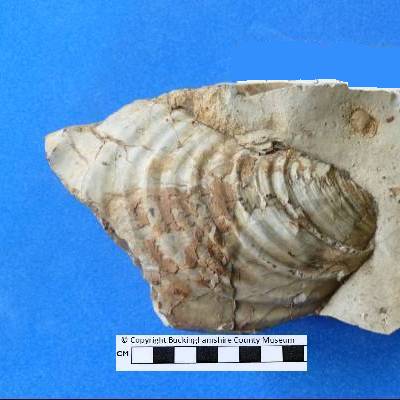 Inoceramus sp. Bivalve in flint, from Chesham Bois. Bucks County Museum - Specimen No. 1919.46.1
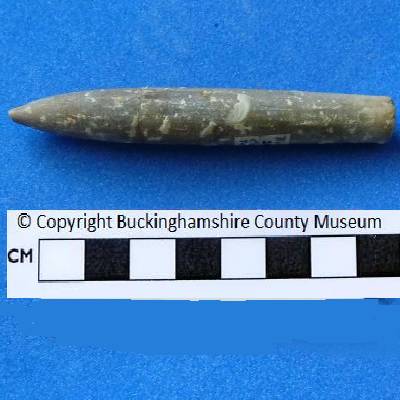 Actinocamax plenus. Belemnite from the Grey Chalk Group. Bucks County Museum - Specimen No. 1969.202.1
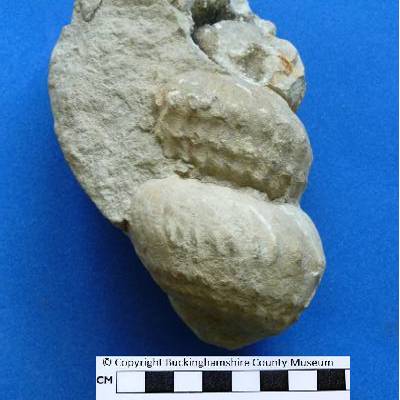 Turrilites sp. From Ivinghoe Churchyard. Ammonite with an acute spiral. Bucks County Museum - Specimen No. 1938.719.1
 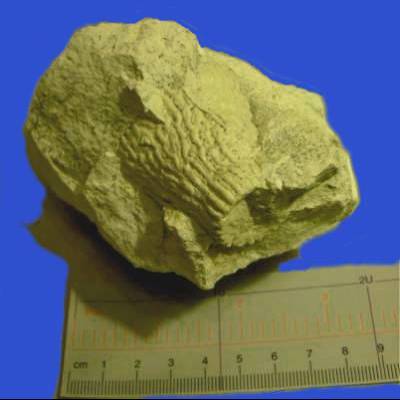 Ventriculites chonoides This sponge fossil is from the White Chalk Group, Kensworth Quarry, Dunstable Down. Hickman Collection - Specimen No. h5b-7. Sponges are simple multicellular animals. The surface contains numerous pores connected to canals and chambers lined by flagellated cells called choanocytes. Sponges are filter-feeders, taking in microscopic plankton by miniature currents created by the choanocytes.
 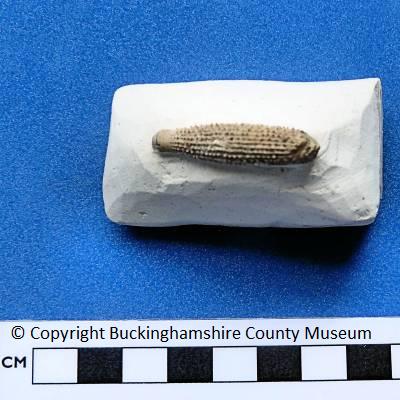 Echinoid spine; Cidaris sceptifera - The specimen on the left is a large spine from an echinoid, some species had many spines often covered with small thorns, spines afforded protection and support. Bucks County Museum - Specimen No. 1982.278.3819
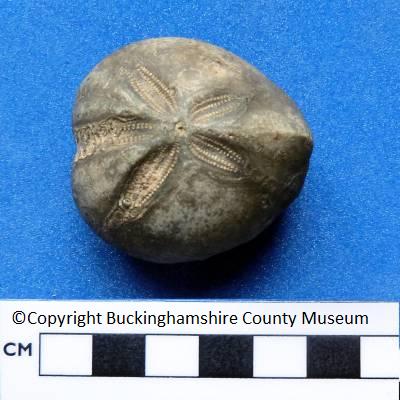 Micraster sp. is a common sea urchin fossil. Often heart-shaped, they are suited for a burrowing life-style. This specimen is preserved in flint. Bucks County Museum - Specimen No. 1965.48.1
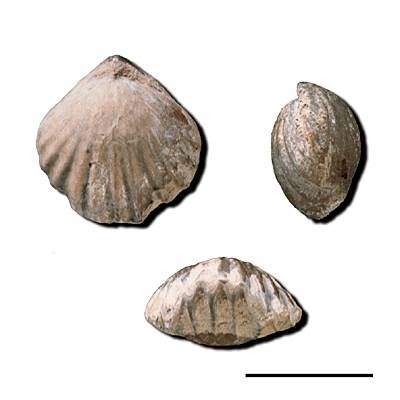 Orbirhynchia mantelliana Brachiopods. Photo courtesy of the Natural History Museum - Specimen No. Lab code 16H8. Scale bar 1cm.
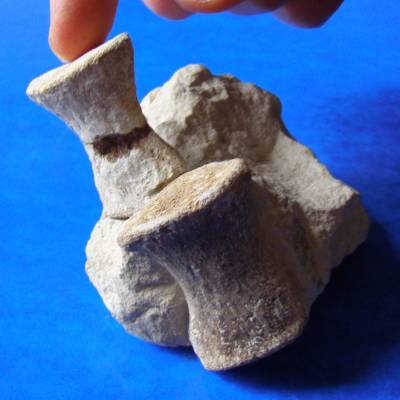 Plesiosaur phalanges, from Totternhoe Stone, Pitstone Pit 1 (now restored to agriculture). Collected in the late 1960s by James Penman of Wendover
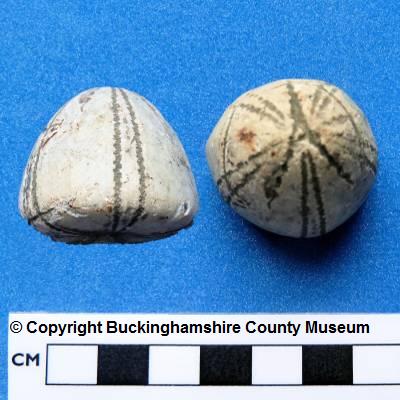 Conulus albogalerus, apical and lateral views of the same echinoid. Bucks County Museum - Specimen No. 1968.61.1
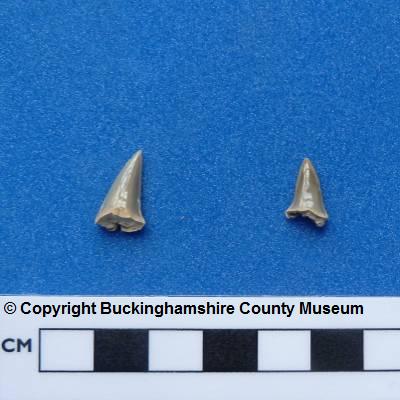 Cretodus sp. Sharks teeth. Bucks County Museum - Specimen No. 1958.38.1
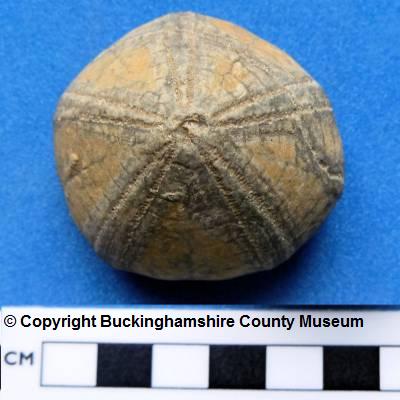 Discoidea sp. Regular echinoid. Bucks County Museum - Specimen No. 1958.16.1
 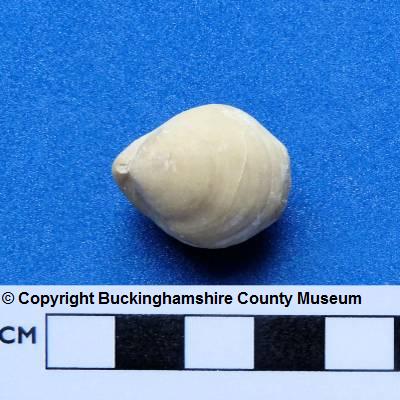 Gibbithyris ellipsoidali Brachiopod. Bucks County Museum - Specimen No. 1955.155.23